
What Does “Too Expensive” Really Mean? How Installers Can Handle Price Objections
Price is one of the most common areas of concern when selling a high-ticket product such as a heat pump or solar installation. A homeowner may look at a quotation and say that it is too expensive, but that statement on its own doesn't tell a salesperson what the actual problem is.
The customer could be concerned about the upfront cost. They might be unsure whether the installation will provide a worthwhile return. They may be comparing the investment with another purchase for their home. Until the salesperson understands which of these concerns is behind the objection, it is difficult to give a useful answer.
This is why effective solar and heat pump price objections handling starts with understanding the question before attempting to answer it.
In InstallrHub's sales training, Brad Clark teaches a six-step framework for handling objections and questions during sales conversations. The framework is designed to give salespeople a structure they can use when customers raise concerns about high-ticket solar and heat pump installations.
Why “too expensive” isn't a complete objection
When a customer says, “I think it's too expensive,” it can be tempting to immediately defend the quotation.
A salesperson might start explaining the quality of the equipment, the expected savings or the potential return on investment.
However, none of those responses may address what the homeowner is actually worried about.
For example, a homeowner might think the installation is too expensive because they simply don't have enough money available upfront. In that situation, explaining the potential ROI doesn't solve the immediate problem. A conversation about finance options would be much more relevant.
Another homeowner might have the money available but be questioning whether the investment is worthwhile. In that case, information about payback, savings and ROI could be much more useful.
The same words can therefore represent very different concerns.
The first step is to find out which concern you're actually dealing with.
Start with clarifying questions
Clarifying questions are an important part of the framework because a salesperson can't give a targeted answer without first understanding the objection.
That doesn't mean turning every objection into a long interrogation. Sometimes one question is enough. Other situations may require several questions before the salesperson has a clear understanding of what the customer means.
The important point is to avoid making assumptions.
If the homeowner says the installation is too expensive, the salesperson needs to establish what they consider expensive and why. Once that is understood, the response can be much more relevant.
As Brad explains in the training, understanding the actual objection can make the eventual response significantly more effective. If the customer's concern is that they don't have the upfront cash, for example, discussing finance options is likely to be far more useful than talking about ROI.
Give the customer space to raise concerns
Once a customer raises an objection, the salesperson doesn't necessarily need to jump straight into their response.
The training recommends using a statement to diffuse the situation first. If a prospect says they need to think about something, for example, responding with “Of course” or “Not a problem” can help create a more comfortable conversation.
The purpose is to make the customer feel that they are allowed to have questions and concerns.
Going immediately into an objection-handling script can make the interaction feel overly sales-focused, which can increase resistance from the customer.
This is particularly important when selling products that can involve a significant investment.
The customer needs to feel comfortable asking questions before they can feel comfortable making a decision.
Empathy helps build trust
The next part of the framework is demonstrating empathy.
This means showing the homeowner that you understand why they have raised the concern and that you're interested in helping them make the right decision.
For example, a homeowner who is hesitant about spending a significant amount of money on their property has a reasonable reason to ask questions. A salesperson shouldn't make them feel as though raising that concern is an inconvenience.
Brad explains that the conversation needs to come from a consultative position rather than feeling like a salesperson is simply trying to secure a commission or make a sale. Demonstrating empathy can increase trust and make the eventual response more likely to resonate with the customer.
Keep your response concise and relevant
Once you understand the objection, the next step is to answer it.
The important word here is targeted.
A common mistake is to respond to one question with a long explanation covering everything that makes solar or heat pumps attractive. The customer may have raised one specific concern, but suddenly they're listening to a five-minute explanation about the entire product.
That can make the conversation less effective rather than more persuasive.
The training recommends keeping the response concise and focused on the main points the customer actually needs to understand.
If the customer is concerned about affordability, address affordability.
If they're questioning ROI, address the financial case.
If they're worried about performance, address performance.
The better the salesperson understands the objection, the easier it becomes to give a concise answer.
Show the customer rather than simply telling them
There are also situations where evidence can make an explanation much more convincing.
Suppose a homeowner is unsure whether a solar installation represents a worthwhile investment. Telling them that the system will save money is one thing. Showing them how their energy bill could change, what the expected payback looks like and what the potential savings could be after payback gives them something concrete to consider.
The training specifically recommends using numbers, graphs and data where possible rather than simply telling the customer why the installation is a good investment.
This doesn't mean overwhelming the homeowner with information.
The evidence should relate directly to the concern they have raised.
The purpose is to make the answer easier for the customer to understand and evaluate.
The 6-Step Approach to Handling Sales Objections
The complete framework taught in the training consists of six main stages. Some elements are optional depending on the situation, but the core process gives salespeople a structure they can use across different objections and questions.
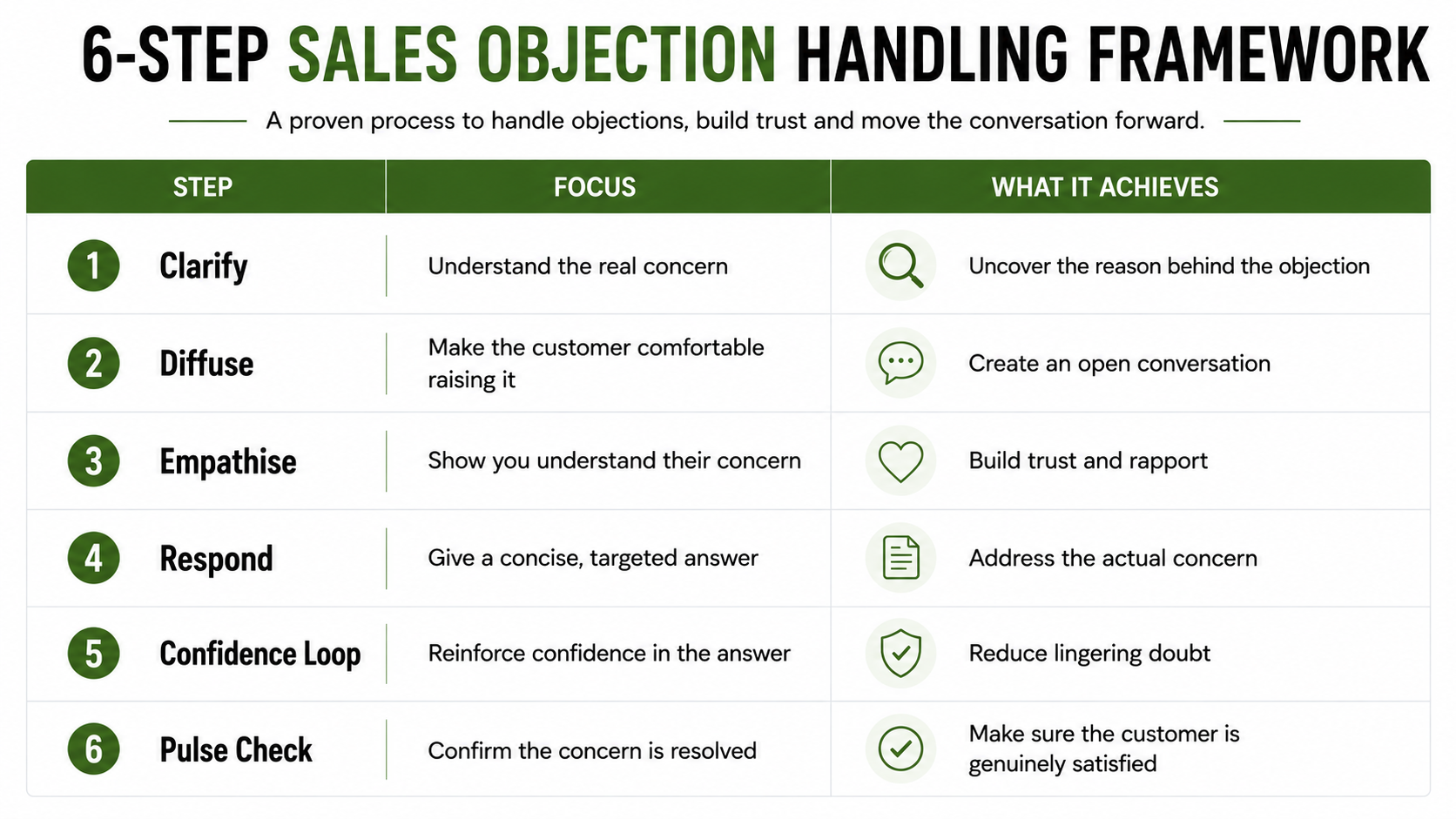
| The sequence matters because it prevents the salesperson from jumping straight into a response before understanding the problem. |
Use a confidence loop to reinforce the answer
The fifth part of the framework is the confidence loop.
The idea is that an objection shouldn't simply be viewed as something that needs to be removed from the conversation. When handled correctly, it can actually increase the customer's trust in the salesperson and their confidence in the decision.
For example, imagine a homeowner is concerned about whether a particular heat pump will perform well during cold weather.
After addressing the concern, the salesperson can reinforce the answer by explaining why they are confident that the specific system being recommended is suitable.
The confidence loop isn't about making unsupported promises. It is about giving the customer a clear reason to feel reassured after their concern has been addressed.
This can be particularly important when a homeowner is considering spending £5,000, £10,000 or £15,000 on an installation. The customer wants to feel confident that they are making the right decision.
Check whether the objection has actually been handled
Answering an objection doesn't necessarily mean the customer is satisfied.
That's why the final part of the framework is the pulse check.
A salesperson can simply ask:
“Does that give you more confidence?”
or:
“Does that clear things up?”
The answer provides immediate feedback about whether the concern has actually been addressed.
But there is another important part to this.
The salesperson shouldn't only listen to what the customer says. They should also pay attention to how they say it.
Someone saying, “Yeah, that's fine,” may still sound uncertain. Someone saying, “Yep, that definitely clears it up,” is giving you a very different signal.
The training specifically highlights the importance of listening to tone because some customers may say yes simply because they don't want to disagree with the salesperson.
What if the customer still sounds unsure?
If the customer gives an unconvincing response, the salesperson shouldn't necessarily move straight towards closing the sale.
There may still be an unresolved concern.
The training recommends gently challenging this rather than becoming confrontational. A salesperson might acknowledge that the customer doesn't sound completely convinced and ask whether there is anything else they'd like explained.
This gives the customer another opportunity to raise the real issue.
If another objection appears, the salesperson can return to the framework and address it properly.
That is much better than assuming the conversation is finished simply because the customer said “yes.”
Why this framework works across different objections
The value of a framework like this is that it doesn't depend on memorising a perfect response for every possible question.
Installers can certainly prepare specific scripts for common objections such as price or “I need to think about it.” Brad recommends doing this as part of a wider sales-training process.
But customers will inevitably raise questions that aren't covered by a script.
A framework gives salespeople something to fall back on.
They can clarify the concern, create a comfortable environment, demonstrate empathy, respond concisely, reinforce confidence and check whether the customer is satisfied with the answer.
That process can be applied to a wide range of questions and objections.
Better objection handling starts with better listening
The biggest lesson isn't necessarily about finding the perfect words.
It's about listening carefully enough to understand what the customer is actually saying.
A homeowner who says “it's too expensive” may need a completely different response from another homeowner using exactly the same words.
Once the salesperson understands that, the rest of the conversation becomes much easier.
The response can be shorter. The evidence can be more relevant. The salesperson can address the actual concern instead of delivering a generic pitch.
Most importantly, the customer can leave the conversation feeling more confident rather than simply feeling that their objection has been argued against.
Improve Your Sales Process With InstallrHub
Generating more enquiries is only part of the equation for a growing installer.
Your sales team also needs the skills and processes to turn those opportunities into appointments and installations.
InstallrHub provides ready-to-quote appointments for heat pump and solar installers, alongside sales training and other support designed to help installers get more from their sales opportunities. Brad explains in the training that the objection-handling framework is part of the wider sales training provided to InstallrHub clients.
If you're an installer looking to increase your flow of solar or heat pump opportunities, you can find out more about working with InstallrHub.
Want to discuss your requirements? Get in touch with InstallrHub