
The 6-Step Framework for Handling Solar and Heat Pump Sales Objections
For many solar and heat pump installers, getting the homeowner into the sales conversation is only part of the challenge. Once a customer is considering spending thousands of pounds on a new heating or energy system, questions and concerns are naturally going to come up.
That makes solar and heat pump sales objections a normal part of the sales process rather than something that should automatically be treated as a problem.
A homeowner might question the price, ask whether the investment will actually pay off, worry about whether a heat pump will work properly, or simply say they need more time to think. The way a sales representative responds can have a significant effect on what happens next.
One common mistake is trying to answer an objection too quickly. Another is giving the customer far more information than they actually need. A response can be technically correct and still fail to address the concern that is actually stopping the homeowner from moving forward.
Brad's approach is to give sales reps a framework they can use when dealing with objections, rather than relying entirely on memorised answers. The framework helps the salesperson understand the concern, respond appropriately and establish whether the response has actually resolved it.
Why Solar and Heat Pump Sales Objections Are Different
Solar and heat pump sales often involve a much larger financial decision than an everyday purchase. A homeowner could be considering an investment of £5,000, £10,000, £15,000 or more, depending on the system and property.
It is therefore reasonable for them to ask questions before committing.
The sales process becomes difficult when the salesperson interprets every question as resistance and immediately tries to overcome it. That can turn a useful conversation into a battle between the homeowner asking for more information and the salesperson trying to close the sale.
The better approach is to understand what the customer is actually concerned about.
For example, saying that something is "too expensive" does not necessarily mean the homeowner thinks the quoted price is unreasonable. They could be concerned about affordability, uncertain about the return on investment, comparing the purchase with another financial priority, or simply unsure whether the system is worth the money.
Those are different problems and should be treated differently.
This is where the framework becomes useful.
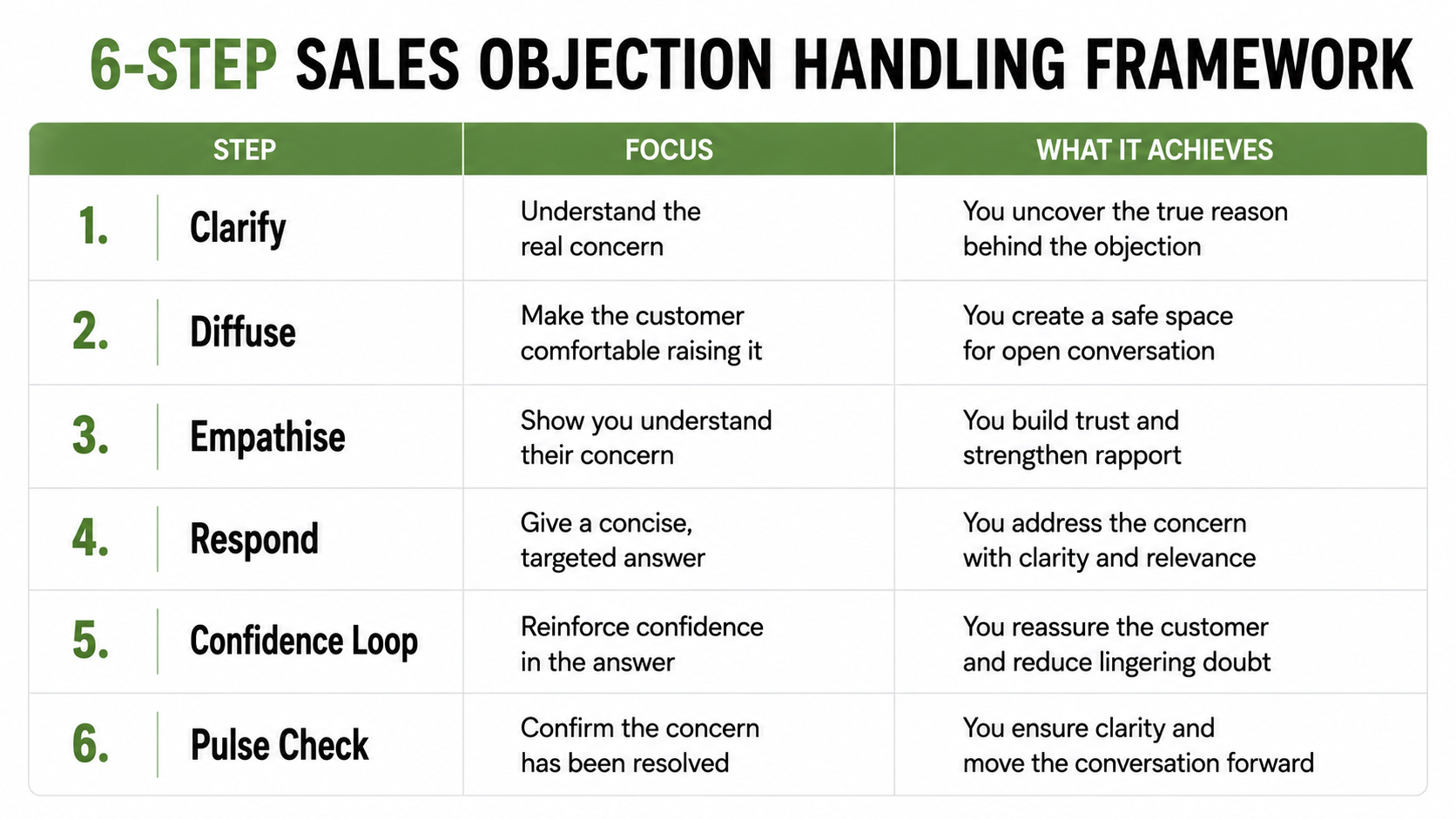
The 6-Step Objection Handling Framework
The process can be broken down into six stages:
- Clarify the objection
- Diffuse the objection
- Demonstrate empathy
- Give a concise, targeted response
- Use a confidence loop
- Finish with a pulse check
Not every customer conversation will look exactly the same. Some objections will require more discussion than others. But having a consistent process gives sales reps something to fall back on when a question doesn't fit neatly into a pre-written script.
1. Start by Clarifying the Objection
The first step is to understand what the homeowner actually means.
This sounds obvious, but it is easy for sales reps to skip. A customer raises a concern and the salesperson immediately starts explaining why that concern shouldn't matter.
Consider the example of a homeowner saying:
"It's too expensive."
That statement is not enough information to know what response is appropriate.
If the homeowner means that they cannot afford the upfront payment, the conversation may need to focus on affordability or finance.
If they mean they don't believe the system will provide a sufficient return, the relevant conversation could involve savings, payback or expected performance.
If they simply believe another installer has offered a lower price, that is another situation altogether.
The salesperson cannot know which one applies without asking.
Clarifying questions therefore give the rep the information needed to provide a relevant answer instead of making assumptions. Brad's training specifically uses the "too expensive" example to illustrate why understanding the meaning behind an objection matters before attempting to respond to it.
The objective isn't to interrogate the homeowner. It is simply to make sure the salesperson is solving the right problem.
2. Diffuse the Objection Before Answering It
Once the salesperson understands the concern, the next step is to diffuse it.
This is particularly useful when a homeowner raises an objection such as:
"I need to think about it."
A common response would be to immediately ask what they need to think about.
That might seem logical, but it can also make the homeowner feel as though they are being pushed into defending their decision.
Instead, the salesperson can first acknowledge the concern and make it clear that the question is completely reasonable.
The purpose of diffusing the objection is not to agree with it. It is to reduce the sense of confrontation around the conversation.
This matters because a homeowner who feels pressured may become less willing to explain what is actually bothering them. The more defensive the conversation becomes, the harder it is for the salesperson to understand the real issue.
Brad's approach is to create some space before moving into the response. That helps prevent the interaction from immediately feeling like a salesperson trying to overcome an objection.
3. Demonstrate Empathy
After acknowledging the concern, the salesperson needs to demonstrate empathy.
This does not mean agreeing with everything the homeowner says. It means showing that the salesperson understands why the homeowner might have that concern.
That distinction is important.
A homeowner considering a major investment wants to feel that the person advising them is interested in helping them make the right decision. If the conversation feels entirely focused on getting the sale, even a technically good answer can lose credibility.
For example, if someone is worried about choosing the wrong installer, immediately telling them why your company is better may not be the best starting point.
Acknowledging why they would want to be careful can create a much more productive conversation.
The salesperson is effectively communicating:
"I understand why this matters to you. Let's work through it."
That puts the conversation in a more consultative position rather than making it feel like a battle between objection and rebuttal. Brad specifically highlights this distinction between being consultative and coming across as overly sales-focused.
4. Give a Concise, Targeted Response
Once the concern has been clarified, diffused and acknowledged, it is time to answer it.
The key word here is targeted.
One of the easiest ways for a salesperson to lose a homeowner's attention is to respond to a specific question with a long explanation covering everything they know about solar or heat pumps.
The homeowner might ask whether the investment will pay back within a reasonable timeframe.
They don't necessarily need a five-minute explanation about every advantage of installing solar.
They need the information that answers the question they actually asked.
This is why the clarifying stage is so important. Once the salesperson understands the concern, the response can be much more specific.
If the issue is affordability, address affordability.
If the issue is return on investment, address the financial case.
If the issue is system performance, explain the relevant performance information.
The goal is not to demonstrate how much the salesperson knows. The goal is to give the homeowner the information they need to make a decision.
Brad specifically emphasises keeping the response concise and focused on the exact thing the customer has raised, rather than delivering a lengthy explanation about the overall benefits of solar.
5. Use a Confidence Loop
After answering the specific concern, the framework introduces a confidence loop.
The idea is to reinforce the homeowner's confidence after the response has been given.
The exact wording will depend on the objection.
For example, if a homeowner is worried about whether a particular heat pump will perform effectively in their circumstances, the salesperson can explain why the proposed system is suitable and then reinforce that conclusion.
The confidence loop should be based on the information already discussed. It isn't an opportunity to introduce another exaggerated claim or launch into another sales pitch.
Its purpose is to leave the homeowner feeling confident about the answer they have just received.
This is particularly important with technical or financial objections. A customer might understand the explanation but still be uncertain about what it means for their decision.
A clear confidence loop helps connect the information back to the decision they are considering. Brad describes this stage as reinforcing the customer's confidence that the concern has been addressed and that the proposed solution makes sense.
6. Finish With a Pulse Check
The final stage is the pulse check.
This is where the salesperson checks whether the response has actually resolved the concern.
It can be as simple as asking whether the explanation makes sense or whether it has cleared up the customer's question.
The reason this matters is that salespeople can easily assume that silence means agreement.
It doesn't.
A homeowner might say "yes" because they don't want to challenge the salesperson. They might technically understand the explanation while still feeling uncertain about buying.
That is why the salesperson needs to pay attention to both the answer and the tone.
A confident response suggests the objection may genuinely have been resolved.
A hesitant response such as "yeah, that sort of clears it up" may suggest that something is still missing.
The pulse check gives the salesperson an opportunity to discover that before moving on.
Brad's framework specifically highlights checking whether the response has landed rather than simply assuming that it has.
What If the Customer Still Doesn't Sound Convinced?
Sometimes the pulse check reveals that the homeowner isn't fully convinced.
That doesn't necessarily mean the conversation is over.
Instead, the salesperson can gently challenge the response and invite the customer to explain what is still bothering them.
For example, if a homeowner gives a hesitant answer, the salesperson can ask whether they are sure or whether there is anything else they would like explained.
The important part is the way this is done.
The purpose isn't to catch the customer out or pressure them into saying yes. It is to find out whether there is another unresolved concern underneath the first one.
A customer might initially raise price, for example, but after discussing the numbers reveal that their real concern is whether the company can be trusted to deliver the installation properly.
If the salesperson simply accepts the first "yes" and moves on, that concern may never be uncovered.
Brad describes this as a challenge stage that can be used when the customer's response does not sound fully convincing.
Don't Just Tell Homeowners, Show Them
There is another important principle running through the framework: show the homeowner whenever possible rather than simply telling them.
Suppose a customer asks whether installing solar will be a good investment.
A salesperson can say:
"Yes, you'll save money."
But that asks the homeowner to take the salesperson's word for it.
A stronger approach is to show them the relevant information.
That could include savings calculations, graphs, energy usage data or payback information.
The homeowner can then see how the numbers relate to their own situation.
This is particularly valuable when dealing with financial objections. Rather than making a broad claim about savings, the salesperson can explain the figures that support the recommendation.
The same principle applies to technical concerns.
If a customer questions whether a system is appropriate for their property, relevant evidence can be much more useful than simply repeating that the system is suitable.
Brad's training specifically discusses using graphs, numbers and data to make the response more tangible and convincing.
The Framework at a Glance
Solar and Heat Pump Sales Objections
The complete process is:
Clarify → Diffuse → Empathise → Respond → Confidence Loop → Pulse Check
The first three stages help the salesperson understand and acknowledge the concern.
The response stage addresses it.
The confidence loop reinforces the answer.
And the pulse check confirms whether the homeowner has actually accepted it.
Why a Framework Is Better Than Relying Only on Scripts
Sales scripts can be useful.
There are certain objections that sales teams hear regularly, and having a prepared response can help a salesperson handle those situations confidently.
But scripts have a limitation.
They can only prepare a salesperson for the objections they've anticipated.
A homeowner may ask something completely different.
They might combine several concerns in one question, challenge an assumption in the proposal, or raise an issue that the sales rep has never encountered before.
This is where a framework becomes more useful than a collection of scripts.
Instead of needing to memorise the perfect answer, the salesperson has a process they can apply to almost any question.
They can first establish what the homeowner means, acknowledge the concern, respond to it, reinforce the answer and then check whether the customer is satisfied.
Brad makes this distinction in the training: scripts can be useful for common objections, while the broader framework gives sales reps a way to handle questions they haven't specifically prepared for.
That makes the framework something sales managers can train into a team rather than simply handing reps another document full of scripts.
Common Mistakes When Handling Solar and Heat Pump Sales Objections
Understanding the framework also highlights several mistakes that can make an otherwise good sales conversation harder.
Responding before understanding
If a salesperson assumes what the homeowner means by "too expensive," they may spend several minutes solving a problem the customer doesn't actually have.
Becoming defensive
A homeowner asking a difficult question isn't necessarily attacking the salesperson or the company. Treating it that way can create unnecessary tension.
Giving too much information
More information isn't automatically more persuasive. If the response doesn't address the customer's actual concern, additional information can simply create more noise.
Treating every objection as something to overcome
Some questions are genuine requests for information. The goal should be to help the homeowner understand their options rather than trying to force every conversation toward a yes.
Moving on too quickly
A homeowner saying "yeah, that's fine" doesn't necessarily mean the concern has disappeared. The pulse check exists for a reason.
Relying entirely on verbal claims
When relevant data, calculations or other evidence are available, showing them can give the homeowner something concrete to evaluate rather than asking them to simply trust the salesperson's statement.
Building Better Objection Handling Into Your Sales Process
The framework becomes most useful when it is incorporated into the wider sales process rather than treated as a one-off training exercise.
Sales managers can use common objections from real appointments to identify where reps are struggling.
If multiple salespeople are hearing the same question, that may indicate an opportunity to develop a stronger standard response.
For example, if homeowners repeatedly question the expected return on a solar installation, the sales team can make sure the relevant figures and explanations are easy for reps to access.
If customers frequently ask whether a heat pump will perform effectively in their particular type of property, the team can prepare relevant examples and evidence.
The objective isn't to script every possible conversation.
It is to make sure salespeople have both the knowledge and process needed to handle conversations confidently.
That is where objection handling becomes part of a scalable sales system rather than simply an individual salesperson's skill.
Conclusion
Solar and heat pump sales objections are a normal part of selling high-value renewable energy systems.
Homeowners have legitimate reasons to ask questions before committing thousands of pounds to a project. The job of the sales rep isn't to eliminate those questions or make the homeowner feel uncomfortable for raising them.
A better approach is to understand the concern first.
Clarifying questions help identify what the homeowner actually means. Diffusing the objection and demonstrating empathy create a more open conversation. A concise response then addresses the specific issue without overwhelming the customer with unnecessary information.
The confidence loop reinforces the answer, while the pulse check gives the salesperson an opportunity to find out whether the concern has genuinely been resolved.
And wherever possible, the salesperson should show rather than simply tell. Relevant numbers, graphs, savings calculations and other evidence can make an explanation much more tangible.
The result isn't a magic script that removes every objection.
It is a repeatable process that gives sales reps a way to handle both familiar objections and unexpected questions.
For solar and heat pump installers, that can make the difference between simply having a conversation with a homeowner and having a sales process that gives the homeowner the confidence to make an informed decision.
Want to improve the sales process behind your leads?
InstallrHub works with solar and heat pump installers through its lead generation and growth services, including sales support and training designed to help installers make more of the opportunities they receive.