Accountability in Business: Why Renewable Installers Stay Stuck
Running a renewable installation business means dealing with factors that are not always within your control. Competition changes, homeowners compare more quotations, marketing performance fluctuates and not every suitable opportunity becomes an installation. These challenges are a normal part of operating in a growing and increasingly competitive sector.
However, the way a business responds to disappointing results can have a significant effect on its long-term growth.
After working directly with more than 150 installers and speaking with hundreds more across the UK, we have noticed a recurring difference between businesses that continue to improve and those that remain at a similar size. Growing installation companies are generally more willing to review their own processes when something goes wrong. Instead of assuming that the market, competitors or lead quality are entirely responsible, they examine the parts of the customer journey that they can influence.
This is what accountability in business should look like. It is not about accepting blame for every lost project. It is about creating a habit of reviewing performance honestly and using the information available to make better decisions.
What Accountability Means for a Renewable Installation Business
Accountability is sometimes misunderstood as taking personal responsibility for every negative result. In practice, that would be neither useful nor realistic. A homeowner may delay a project because their financial circumstances change. A property may turn out to be unsuitable. Another installer may offer a significantly lower price that your business cannot reasonably match.
An accountable business recognises these external factors while still reviewing whether anything within its own process could have been improved.
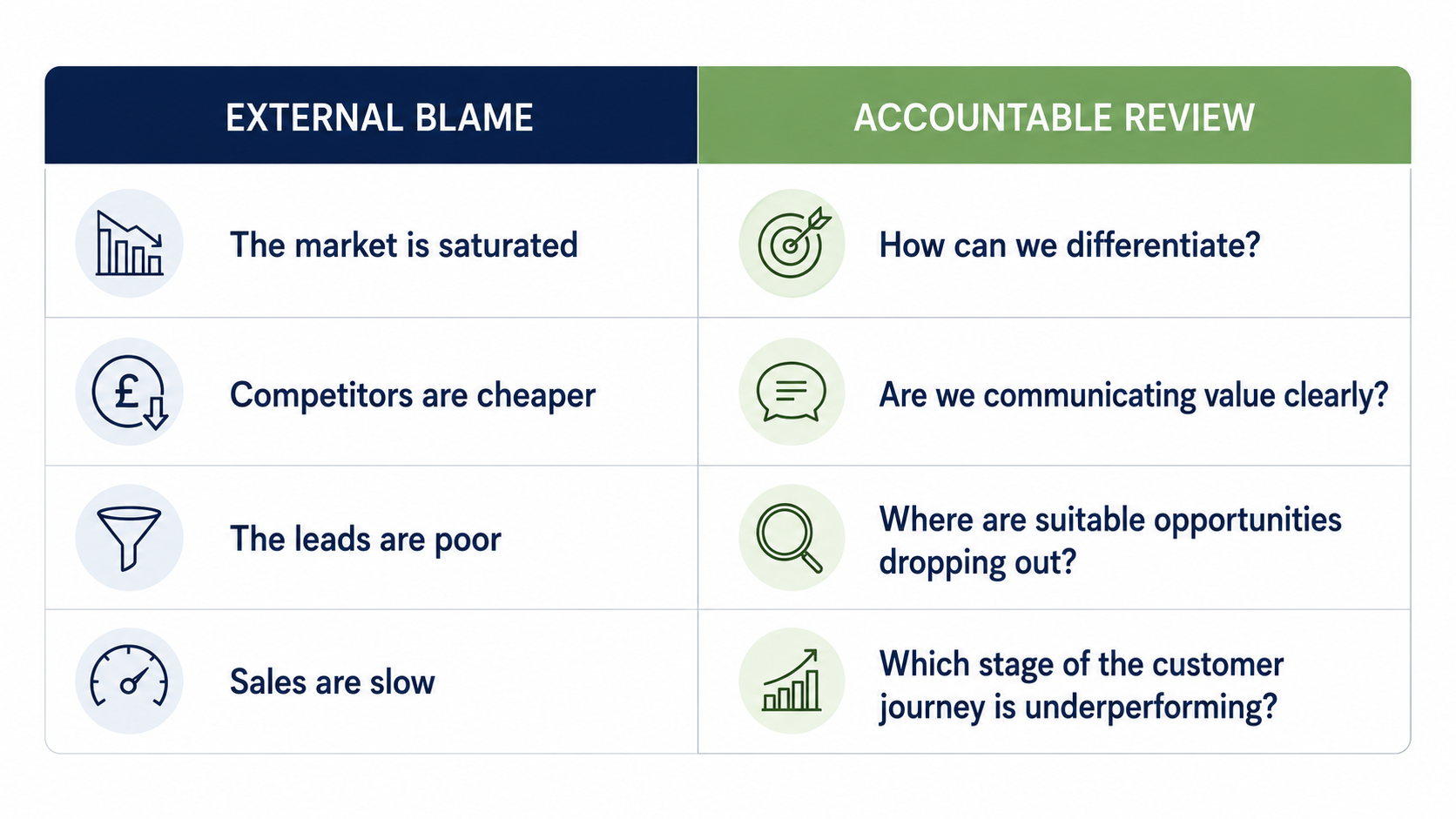
For example, if several homeowners choose cheaper competitors, the immediate conclusion may be that pricing is the problem. Reducing prices might appear to be the obvious response. Before changing margins, however, it is worth reviewing how the business communicates value during the survey and quotation process.
Did the homeowner understand the difference between the proposed systems? Was the recommendation connected clearly to the problem they wanted to solve? Did the quotation explain what was included and why? Was there a structured follow-up conversation after the proposal was sent?
If these areas are unclear, reducing the price may treat the symptom without addressing the underlying weakness.
The same principle applies to marketing and lead generation. Poor-quality opportunities do exist, and installers should expect providers to be transparent about how enquiries or surveys are qualified. However, when suitable homeowners repeatedly enter the sales process without progressing, the business also needs to examine what happens after the opportunity arrives.
Why External Blame Can Hide Internal Problems
The main risk of blaming external factors is not simply negativity. The larger problem is that it can prevent useful investigation.
If an installation company decides that the market is saturated, it may accept slower growth as unavoidable. Yet another company operating in the same region may be winning work because it has developed a stronger proposition, communicates more clearly or responds to homeowners more quickly.
Likewise, if every lost quotation is attributed to competitors being cheaper, the business may never assess whether its own sales process gives homeowners a compelling reason to pay more.
Brad highlights this distinction when comparing installers that remain stuck with those that continue growing. The latter tend to look for ways to differentiate themselves, refine their sales process and seek feedback from opportunities that did not convert.
The purpose of this review is not to prove that the business was at fault. It is to determine whether a pattern exists and whether the company has an opportunity to improve.
Lost Quotations Can Reveal Problems in the Sales Process
A lost quotation is often treated as the end of an opportunity. The homeowner has chosen another installer or decided not to proceed, so the team moves on to the next enquiry.
While this is understandable, consistently moving on without seeking feedback can leave valuable information unused.
Suppose an installer loses ten quotations over a period of several weeks. One homeowner says the price was too high, another says they were not ready and a third simply stops responding. Viewed individually, these outcomes may appear unrelated.
If the business begins collecting feedback more consistently, a clearer pattern may emerge. Perhaps homeowners regularly receive the final investment figure later than expected. The quotation may contain extensive technical information but fail to explain how the proposed system addresses the homeowner's original concerns. Follow-up may also be inconsistent, leaving potential customers to compare options without further guidance.
These are problems that can be addressed.
A stronger qualification process could introduce realistic investment expectations earlier. Surveyors could be trained to connect technical recommendations with the homeowner's motivation. A structured follow-up process could ensure that every quotation receives appropriate attention.
Brad's wider discussion of lead quality makes a similar point: an opportunity failing to become an installation does not automatically prove that the original lead was poor. Pricing, objection handling and the structure of the sales journey can also affect the result.
Customer Feedback Should Be Part of Business Improvement
Many installers already collect reviews from successful customers. Positive reviews are important for reputation and social proof, but feedback from lost opportunities can be equally useful for internal improvement.
The process does not need to be complicated. A short email or telephone conversation can ask why the homeowner chose another provider or decided not to continue. Not every customer will respond, and individual comments should not automatically trigger major changes. The objective is to identify recurring themes over time.
For example, repeated feedback about slow communication may indicate a response-time problem. Frequent confusion around quotations may suggest that proposals need to be simplified. If homeowners consistently say another installer explained the project more clearly, sales training may deserve more attention.
The most useful feedback is often specific enough to guide action. Rather than asking only whether the customer was satisfied, installation businesses can ask what influenced the final decision and whether any part of the process could have been clearer.
When this information is reviewed alongside booking and conversion data, the company gains a better understanding of why opportunities are being won or lost.
Accountability Does Not Mean Ignoring Genuine Lead Quality Problems
There is an important balance to maintain. Installation businesses should not use accountability as a reason to accept unsuitable opportunities or excuse poor performance from a lead provider.
Anyone can submit an online form, and limited qualification can create inconsistent results. Brad has previously highlighted that stronger qualification should consider property suitability, customer intent and budget expectations before an opportunity reaches an installer.
If a company repeatedly receives enquiries from tenants, unsuitable properties or homeowners with no realistic intention of moving forward, the source of those opportunities should be reviewed.
Accountability becomes relevant once the business separates genuine qualification issues from weaknesses in its own process.
For example, if ten unsuitable homeowners are sent to the sales team, the lead source may be the obvious problem. If ten suitable homeowners with genuine intent complete surveys but none become installations, the survey-to-sale process deserves closer examination.
The distinction matters because the solution is different in each situation. Better qualification may improve the first problem, while sales training, quotation improvements or stronger follow-up may be required for the second.
A Practical Monthly Accountability Review
Accountability is most effective when it becomes part of the company's normal operating process rather than a reaction to a particularly poor week.
A monthly review can begin by looking at the full customer journey from initial opportunity to completed installation. The management team should compare the number of opportunities received, surveys booked, surveys completed, quotations issued and installations won.
The next step is to identify the largest drop in the process. If opportunity volume is healthy but survey bookings are low, the initial contact or qualification process may need attention. If surveys are completed but quotation conversion is weak, the sales process should be reviewed. If conversion is strong but overall installation volume remains below target, the company may simply need more suitable opportunities.
Customer feedback can then provide context around the numbers. Comments about pricing, communication, delays or unclear proposals may explain why a particular stage is underperforming.
A simple review framework can include:
- Identify the largest drop in the customer journey.
- Review customer feedback connected to that stage.
- Choose one process to improve.
- Assign responsibility for the change.
- Measure the result during the next review period.
This prevents the business from changing several areas at once and makes it easier to understand whether an improvement has actually worked.
Accountability Creates More Options for Growth
Renewable installers cannot control every market condition or customer decision. They can, however, improve how their business responds to those conditions.
A company that understands why quotations are being lost can strengthen its sales process. A business that identifies weak follow-up can introduce a clearer system. An installer that recognises poor qualification can change how opportunities are assessed before valuable survey time is committed.
This is why accountability is so closely connected with business growth. It directs attention towards areas where action is possible.
The strongest installation businesses are not those that never experience poor results. They are the businesses that review those results, identify useful patterns and make informed changes before the same problems become permanent.
If your team has a strong survey and sales process but inconsistent appointment volume is limiting growth, InstallrHub allows renewable installers to claim qualified, pre-booked heat pump and solar surveys in the areas they cover.
Ready to fill your surveyors' diaries? Claim your pre-booked appointments here: