Why Data-Driven Decisions Help Renewable Installers Grow
Business owners make decisions every day about marketing, staffing, sales and future investment. In a renewable installation company, those decisions can directly affect survey volume, installation capacity and profitability.
The difficulty is that many important decisions are still influenced by recent experiences rather than consistent performance data. A poor week of enquiries may create doubts about a marketing source. A busy month may encourage the business to pause activity. A large advertising bill can feel excessive before the return it generated has been properly calculated.
After speaking with hundreds of renewable installers, we have seen a recurring difference between growing companies and those that struggle to scale. Businesses that understand their key numbers are generally better equipped to identify problems and make longer-term decisions. Installers that do not track performance often rely more heavily on gut feeling, which can lead to short-term reactions.
Data-driven decision-making does not require a complicated reporting department or an expensive analytics platform. It begins with understanding how opportunities move through the business and measuring the stages that have the greatest effect on growth.
Why Gut Feeling Is Not Enough
Experience remains important in any installation business. An experienced director may recognise changes in customer behaviour or notice that the quality of recent conversations feels different.
The problem occurs when those observations become the only evidence used to make a significant business decision.
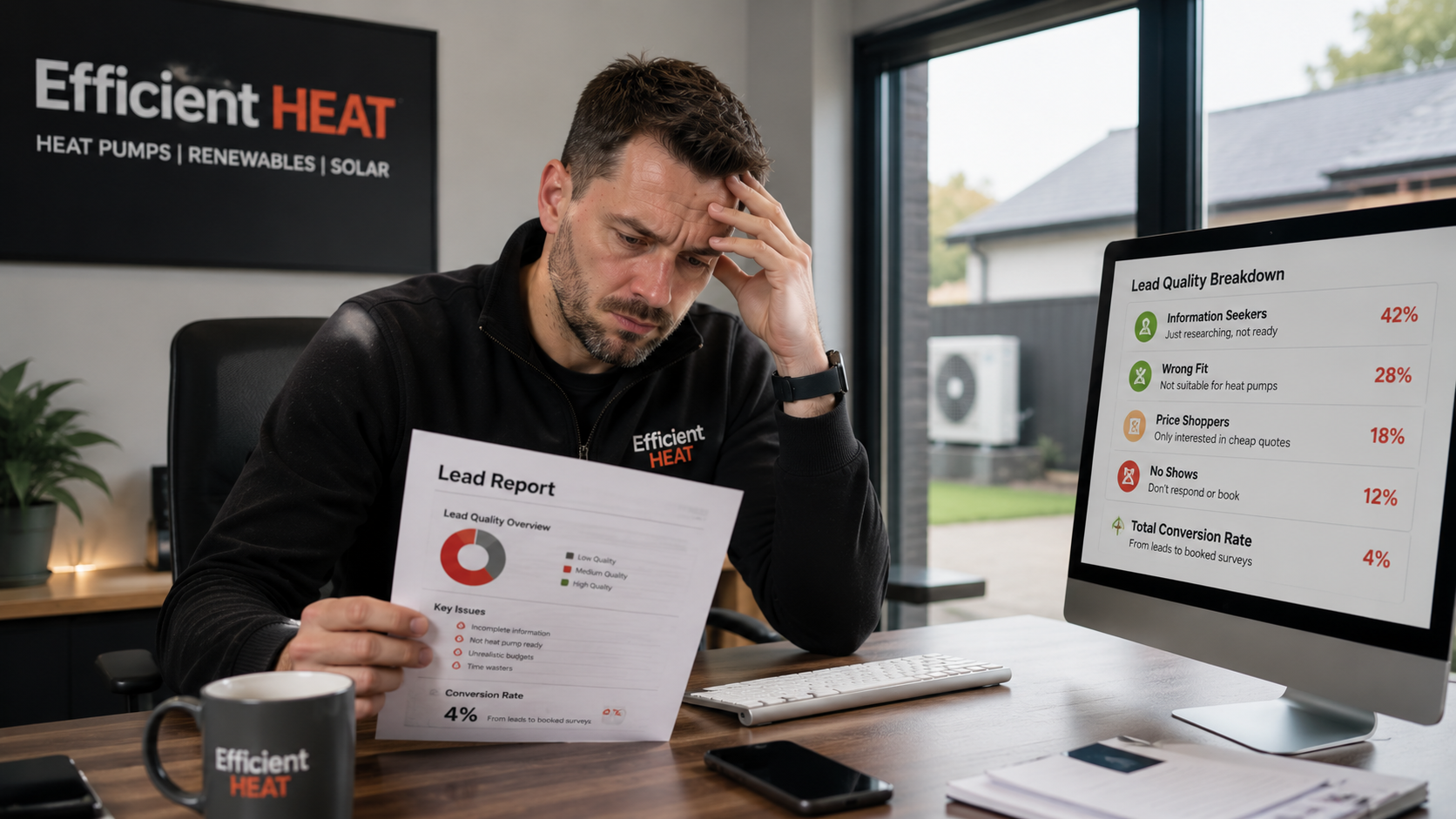
Consider an installer that receives several poor enquiries in one week. The team may conclude that its current lead source has stopped working and immediately reduce spend. However, a review of the previous three months may show that booking rates and installation conversions remain profitable overall.
The opposite situation is equally possible. A business may feel that marketing is performing well because the team is receiving plenty of enquiries. If very few of those opportunities become surveys or installations, high enquiry volume may be hiding a weak commercial return.
Recent experiences naturally influence perception. Data provides a wider view of performance and helps business owners determine whether a problem is temporary or part of a larger trend.
The Numbers Renewable Installers Should Understand
The purpose of tracking performance is not to create reports that nobody uses. Each metric should help the business answer a practical question about its pipeline.
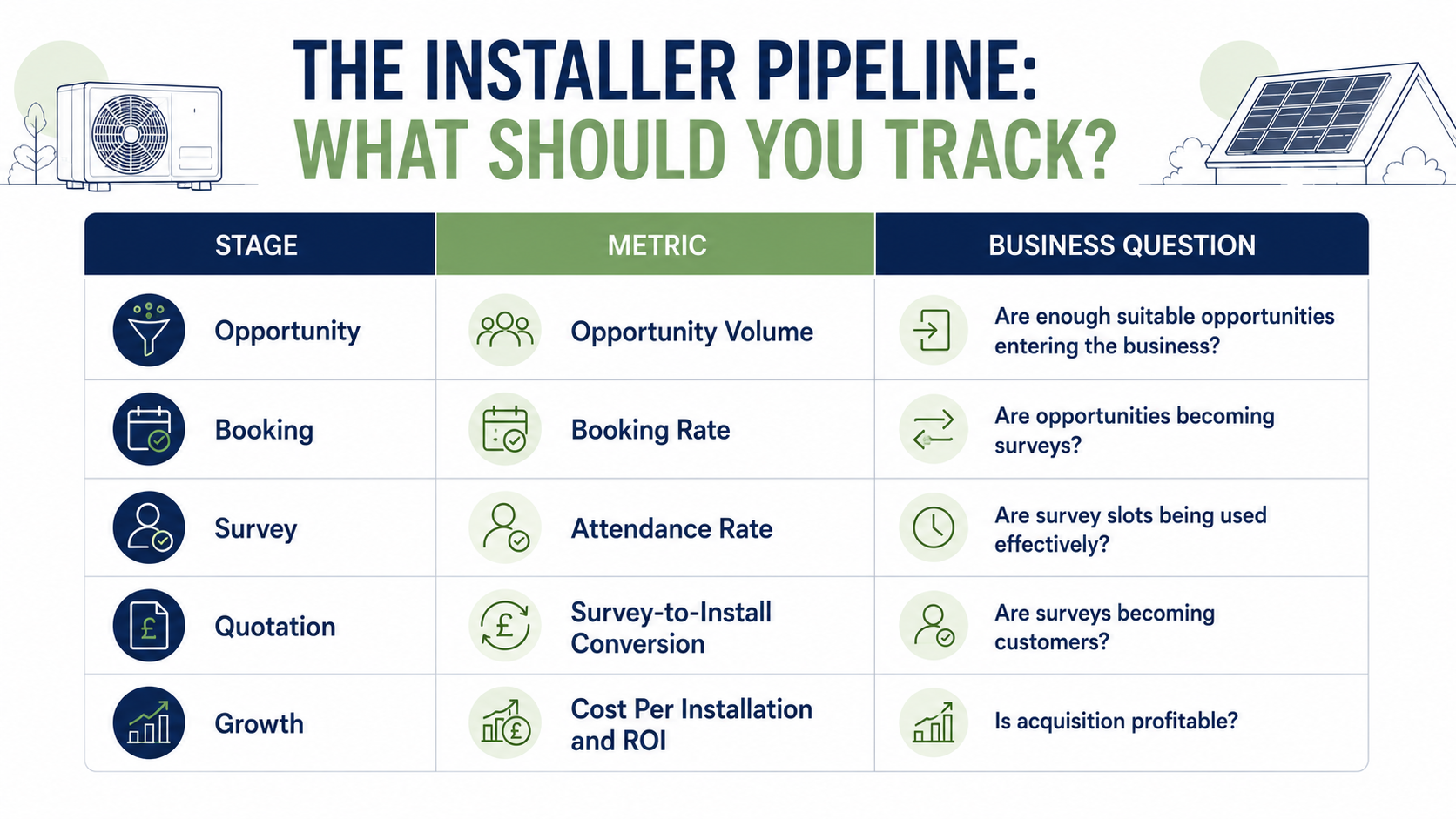
For most solar and heat pump installation companies, several numbers provide a useful starting point.
Opportunity volume shows how many potential projects are entering the business during a defined period.
Booking rate measures how effectively suitable opportunities become surveys or appointments.
Survey attendance rate helps identify cancellations and no-shows that may be wasting diary capacity.
Survey-to-install conversion rate shows how effectively completed surveys become customers.
Marketing or opportunity cost provides visibility over the amount being invested to generate new business.
Cost per installation connects acquisition spend with actual commercial outcomes.
Return on investment helps the company assess whether an activity is creating enough value to justify continued or increased investment.
Brad specifically identifies conversion rates, monthly lead volume, spend, booking rates and ROI as numbers that growing installers are more likely to understand and track.
These metrics are most valuable when reviewed together. A single number rarely explains the entire customer journey.
Data Helps Identify the Real Bottleneck
One of the most useful benefits of performance tracking is the ability to identify where growth is being restricted.
An installation company may believe that it needs more opportunities because monthly installation numbers are below target. Increasing marketing spend seems like the logical solution.
However, the pipeline may already contain enough opportunities to achieve the target.
If 100 suitable opportunities enter the business but only a small percentage become booked surveys, the immediate problem is unlikely to be volume. The company may need to review response times, qualification or the initial conversation with homeowners.
If survey bookings are healthy but very few completed surveys become installations, attention should move further down the customer journey. The survey process, quotation, pricing, objection handling or follow-up may require improvement.
Alternatively, an installer may have strong booking and conversion rates but still lack enough projects to meet its installation capacity. In this situation, increasing opportunity volume may be exactly the right decision.
Without data, all three businesses could reach the same conclusion: they need more leads.
In reality, each has a different problem and requires a different solution.
This is particularly important for companies trying to break through a growth plateau. Inconsistent lead flow and limited visibility over pipeline performance can make it difficult to recognise when results begin trending in the wrong direction.
Measure Performance Further Down the Pipeline
Cost per lead is one of the most common marketing metrics discussed in the installation sector. While it can be useful, it should not be treated as the final measure of performance.
A cheaper opportunity does not automatically produce a lower customer acquisition cost.
For example, one source may generate a high volume of inexpensive enquiries. If the sales team spends significant time contacting them, booking rates remain low and very few become installations, the apparent saving at the top of the pipeline may disappear.
Another source may cost more at the initial opportunity stage but produce homeowners with clearer intent and stronger property suitability. If more of those opportunities attend surveys and become customers, the cost per completed installation may be lower.
This is why installation businesses should follow performance beyond the first enquiry.
The commercial question is not simply how much an opportunity costs. The business needs to understand how much it is spending to generate surveys, quotations and ultimately installations.
Tracking performance further down the pipeline also makes comparisons between different acquisition channels more useful. Referrals, paid advertising, third-party opportunities and pre-booked surveys can produce very different volumes and conversion patterns.
The strongest channel is the one that contributes effectively to the company's growth objectives and delivers a commercially sustainable return.
Avoid Making Decisions From One Good or Bad Week
Renewable installation businesses can experience natural fluctuations in opportunity volume. Advertising performance can change, referrals may arrive inconsistently and customer demand can respond to wider market conditions.
A single week therefore provides limited evidence for a major strategic decision.
If a campaign performs poorly for several days, immediately stopping it may prevent the business from understanding whether the decline was temporary. Similarly, one strong week should not automatically justify a large increase in spending without considering whether the performance is sustainable.
This is where trend analysis becomes valuable.
Weekly data can help management identify immediate operational issues, while monthly and quarterly reviews provide a broader view of business performance. Comparing booking rates, conversion rates and acquisition costs over time makes it easier to distinguish temporary fluctuations from persistent problems.
The review period should match the decision being made. A same-day issue with survey cancellations may require immediate action. A decision about increasing marketing investment should normally be based on a larger and more representative set of results.
Turn Business Data Into Action
Collecting numbers has little value if the information never influences the way the company operates.
A useful performance review should end with a clear decision or area for investigation.
If booking rates are declining, the company may review response times and the conversations taking place before a survey is arranged.
If survey attendance is poor, confirmation and reminder processes may need improvement.
If completed surveys are not converting, management may listen to sales conversations, review quotations or analyse customer feedback.
If conversion is strong and surveyors have empty diary slots, the company can investigate ways to increase suitable opportunity volume.
The objective is to connect each metric with an operational response.
Installation businesses should also avoid changing several processes simultaneously. If marketing, qualification, sales scripts and pricing are all changed at once, it becomes difficult to understand which adjustment affected the result.
A more structured approach is to identify the largest bottleneck, make a targeted improvement and compare performance over the next review period.
Build a Simple Monthly Performance Review
For many renewable installers, a basic monthly review is enough to create greater visibility over the pipeline.
The management team can begin by recording:
- The number of new opportunities received.
- The number of surveys booked.
- The number of surveys completed.
- The number of quotations issued.
- The number of installations won.
- Total acquisition or marketing spend.
- Cost per completed installation.
These figures can then be compared with the previous month and the company's growth targets.
The review should focus on changes rather than isolated numbers. If booking rates have declined for three consecutive months, the company has a trend worth investigating. If survey-to-install conversion improves after a change to the sales process, the business has evidence that the adjustment may be working.
As reporting becomes more consistent, companies can add further metrics that reflect their specific operation. The starting point, however, should remain simple enough to review regularly.
Better Data Creates Better Growth Decisions
Growing an installation business requires investment. Companies may need to increase marketing budgets, recruit surveyors, expand installation teams or introduce new systems.
These decisions become significantly more difficult when the business does not understand its current performance.
Data cannot remove every risk, but it can provide greater clarity. An installer with strong survey-to-install conversion and unused installation capacity has a clearer reason to increase opportunity volume. A company with declining conversion can address the sales process before spending more money at the top of the pipeline.
The businesses that scale successfully are often not those that make the most aggressive decisions. They are the companies that understand their performance well enough to recognise where investment is most likely to produce a return.
If your numbers show that your surveyors have capacity but inconsistent appointment volume is limiting growth, InstallrHub allows renewable installers to claim qualified, pre-booked heat pump and solar surveys in their selected coverage areas.
Ready to fill your surveyors' diaries? Claim your pre-booked appointments here: