
Growth Mindset in Business: How Renewable Installers Scale
Growth is often discussed as though it is the natural result of receiving more enquiries or completing more installations. In practice, expanding a renewable installation business requires a series of decisions about investment, capacity and risk.
An installer may have a profitable marketing campaign but hesitate to increase the budget. Another company may have surveyors with full diaries but delay recruitment because adding staff feels premature. Some businesses repeatedly pause marketing when workloads increase, only to restart activity once the pipeline begins to fall.
These decisions are understandable. Growth introduces uncertainty, and business owners need to protect cash flow, customer experience and the quality of their installations.
However, after working with more than 150 installers and speaking with hundreds more across the UK, we have seen that growing businesses often respond differently when an opportunity is supported by strong results. Rather than automatically slowing down, they assess what would be required to create additional capacity.
A growth mindset in business is not about expanding at any cost. It is the ability to recognise a genuine opportunity, evaluate the evidence and make deliberate decisions that support the company's long-term objectives.
A Growth Mindset Is Not Reckless Expansion
The phrase “growth mindset” can easily be misunderstood in a business context. It does not mean increasing advertising spend regardless of performance, hiring employees before there is enough work or pursuing every available opportunity.
Sustainable growth still requires financial discipline.
The difference lies in how a business responds when the existing numbers show that something is working.
Consider an installation company with strong survey-to-install conversion, available installation capacity and a profitable source of new opportunities. If the owner wants to increase monthly installation volume, maintaining exactly the same level of activity is unlikely to produce a significantly different result.
At some point, the business must decide whether it is prepared to invest more in the activity that is already generating a return.
A growth-focused company reviews the risk, understands the numbers and decides whether the opportunity supports its objectives. A more fixed approach may continue delaying the decision even when the business has clear evidence that additional investment could be justified.
This distinction is important because opportunities do not always remain unchanged. Marketing costs can increase, competitors can enter a region and market conditions can shift. Businesses that take too long to act may find that the same opportunity is less attractive several months later.
Why Installation Businesses Pause When They Become Busy
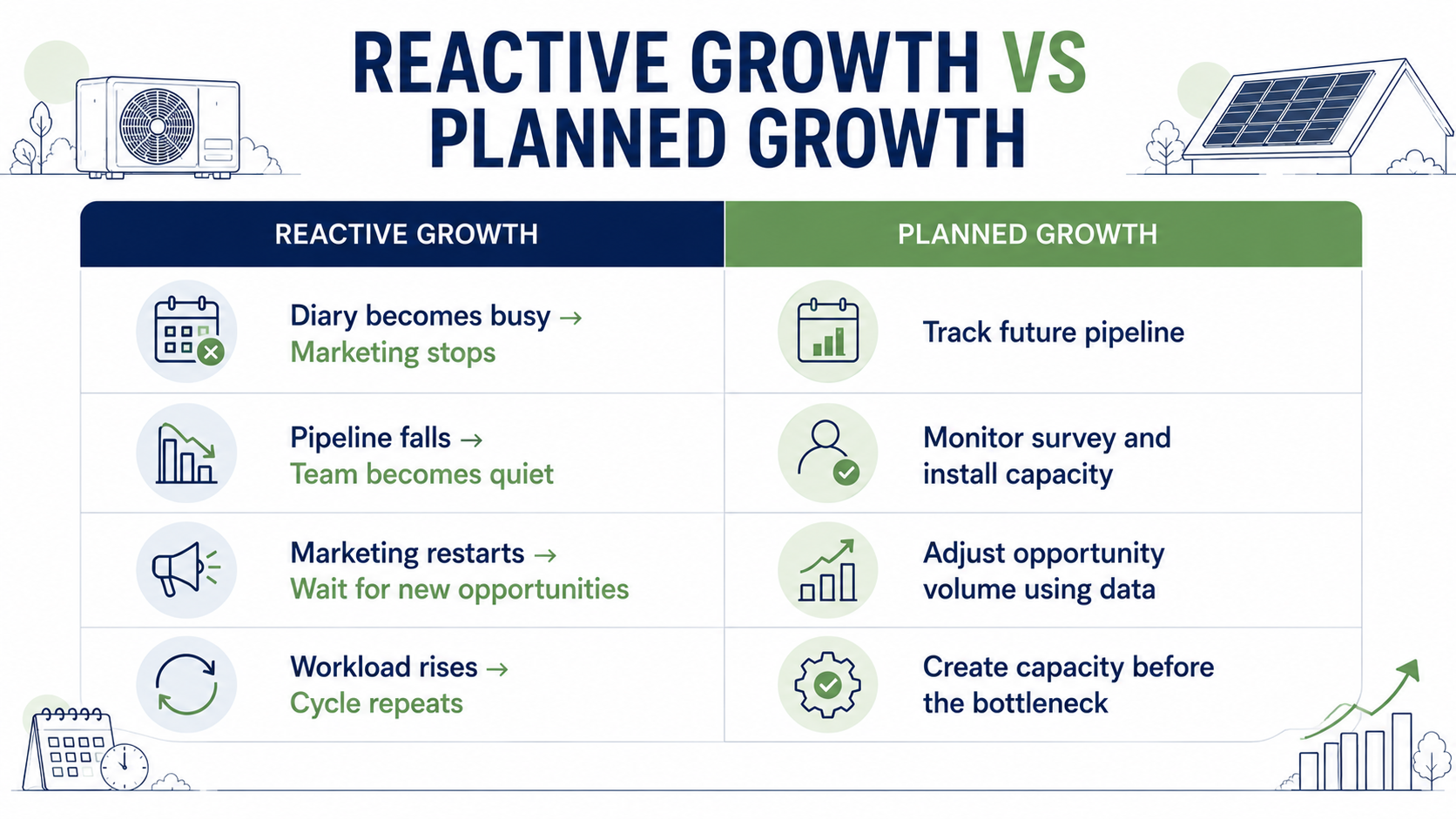
One of the most common patterns in installation businesses is the decision to reduce marketing when the diary becomes full.
Initially, this appears logical. The team already has work, surveyors are busy and generating more opportunities could create additional pressure.
The problem is the delay between marketing activity and completed installations.
A homeowner may enter the pipeline today, complete a survey later and take additional time to review a quotation before making a final decision. If marketing is paused only when the business feels busy, the effect may not become visible until several weeks later.
By then, the existing workload may have reduced and the pipeline may no longer contain enough opportunities to replace completed projects.
Marketing is restarted, but the company must wait for the customer journey to rebuild.
This creates a cycle of inconsistent demand. Busy periods lead to reduced pipeline activity, which eventually creates quieter periods. Quiet periods trigger renewed marketing, which later creates another increase in workload.
A growth mindset does not require businesses to ignore capacity. Instead, it encourages owners to manage pipeline activity with greater awareness of future demand.
Growth Requires Capacity, Not Just More Opportunities
Increasing opportunity volume is only useful when the business can manage what happens next.
If a company generates twice as many suitable homeowners but does not have enough survey capacity, appointment delays may increase. If sales performance improves without sufficient installation capacity, project lead times may become longer. Additional installations can also create pressure on administration and customer communication.
For this reason, growing businesses regularly assess which part of the operation is likely to become the next constraint.
A company may currently need more survey opportunities. Once those diaries are full, the next requirement could be another surveyor. Higher quotation volumes may then expose weaknesses in administration or follow-up. Increased sales can eventually require additional installation teams.
Growth therefore moves the bottleneck.
Business owners need to understand that solving one capacity problem may reveal another. This is not necessarily a sign that the growth strategy has failed. It is often a normal consequence of increasing volume.
The important task is to identify the next limitation early enough to respond before it begins damaging customer experience or business performance.
Use Data to Decide When to Invest
Growth mindset and data-driven decision-making should work together.
An installer should not increase marketing spend simply because the owner feels ambitious. Likewise, a company should not hire additional employees solely because the team has experienced one unusually busy week.
Investment decisions become stronger when they are supported by consistent performance.
Before increasing opportunity volume, a business may review survey availability, booking rates, conversion rates and installation capacity. If the existing pipeline converts profitably and the team has room for additional work, increasing volume may be reasonable.
Before recruiting, the company can assess whether current workload trends are sustained and whether the existing team is regularly approaching capacity.
The same principle applies to marketing. If a campaign or acquisition source repeatedly produces commercially valuable results, the business can examine whether additional investment is likely to create a similar return.
Brad's discussion of growing installers highlights this willingness to use results when making expansion decisions. Businesses with a growth mindset are more likely to double down when an activity is performing well, while more cautious companies may stop at the first comfortable level of success.
Neither approach should ignore risk. The purpose of tracking performance is to make the risk easier to assess.
The Difference Between Maintaining and Scaling a Business
Not every renewable installation company needs to pursue aggressive growth.
Some owners deliberately want a smaller team, a defined service area and a manageable level of installations. If the business provides the income and working structure the owner wants, maintaining that position can be a valid strategy.
Problems arise when the stated objective and the company's decisions do not match.
A business may say it wants to double monthly installation volume while repeatedly reducing marketing whenever survey diaries fill. An owner may want to expand into new areas but remain unwilling to delegate any operational responsibility. A company may set ambitious revenue targets without creating the survey or installation capacity required to achieve them.
Scaling requires different decisions from maintaining.
The business may need to invest before every additional cost feels completely comfortable. Processes may need to change. The founder's role may evolve, and additional management visibility may be required.
This does not mean abandoning caution. It means recognising that a larger business cannot always be built using exactly the same operating model that supported a smaller one.
When Strong Results Create an Opportunity to Scale
One of the examples discussed in Brad's analysis of successful installers is SmartWay Energy. The significance of the example is not simply that the company wanted to grow. It is how the business responded when an activity was producing strong results.
Rather than treating good performance as a reason to become comfortable, the company considered how it could increase activity and create additional capacity.
This principle can be applied more broadly across renewable installation businesses.
If a survey process is converting strongly, the business can investigate whether more suitable appointments can be added.
If a marketing channel consistently produces a positive return, management can assess whether additional investment is justified.
If a particular region is generating strong demand, the company can examine whether expanding capacity in that area makes commercial sense.
The important point is that growth decisions should begin with evidence of what is already working.
Businesses do not always need to search for a completely new strategy. In some cases, the next stage of growth comes from identifying a successful process and determining whether it can be repeated at a greater volume.
Create a Capacity Plan Before Increasing Volume
Before scaling opportunity generation, installation companies should review the full customer journey.
A basic capacity plan can consider four areas:
Survey Capacity
How many additional appointments can the current survey team realistically complete each week without creating excessive travel or delays?
Sales Capacity
Can quotations and follow-up be managed effectively if survey volume increases?
Installation Capacity
How many additional projects can existing teams complete while maintaining quality and realistic lead times?
Operational Capacity
Can administration, scheduling and customer communication support the additional workload?
Reviewing these areas helps the business identify where investment may be required first.
For example, increasing pre-booked survey volume may not make sense if every available survey slot is already occupied. In that situation, creating survey capacity becomes the immediate priority.
Alternatively, a company with empty survey diaries and strong installation capacity may have a clear opportunity-generation problem.
A capacity plan allows the business to match growth activity with operational reality.
Sustainable Growth Comes From Deliberate Decisions
Renewable installation businesses operate in a market where demand, competition and customer expectations can change. There will rarely be a perfect moment to increase investment, recruit or expand activity.
The objective is not to remove every element of uncertainty. It is to make growth decisions using enough information to understand the opportunity and the potential constraint.
Businesses with a growth mindset are willing to improve systems, create capacity and increase investment when performance supports the decision. They do not assume that a strong month will automatically continue without further action, and they do not repeatedly stop pipeline activity simply because the current diary appears busy.
Most importantly, they align their decisions with the type of business they are trying to build.
If the goal is to increase installation volume, the company needs enough suitable opportunities entering the pipeline and enough capacity to convert and deliver the resulting work.
For renewable installers with available survey capacity, InstallrHub provides access to qualified, pre-booked heat pump and solar surveys that can be claimed according to coverage area.
Ready to fill your surveyors' diaries? Claim your pre-booked appointments here: