
Why Renewable Installers Need to Think Like Business Owners to Grow
Many renewable installation companies begin with technical expertise. An experienced heating engineer, electrician or installer builds a strong reputation, receives more recommendations and eventually creates a business around the work they already know how to deliver well.
This technical background provides an important foundation. Customers need competent installers, projects must be designed correctly and poor workmanship can quickly damage a company's reputation.
However, technical ability alone does not automatically create a scalable installation business.
As demand increases, the owner must manage more than the quality of work completed on site. Marketing needs to generate a consistent pipeline. Enquiries must be handled effectively. Surveys, quotations and follow-up need clear processes. Staff require training, and operational decisions become more complex as installation volumes increase.
For many installers, this is where growth begins to slow. The skills that helped establish the company are no longer enough to manage its next stage.
Learning how to grow a renewable installation business therefore requires a change in the owner's role. Technical knowledge remains valuable, but the owner must also begin thinking about the wider systems that allow the company to operate and expand.
Technical Expertise Is the Foundation, Not the Full Business Model
A technically excellent installer can still struggle to build a predictable business.
The company may complete high-quality work and receive strong customer reviews but remain dependent on referrals. Marketing may only restart when the diary becomes quiet, while quotations and follow-up are managed differently depending on who handles the homeowner.
These problems are not related to installation quality. They are business problems.
As a company grows, several functions must work together:
- Marketing must create suitable opportunities.
- Qualification must identify homeowners worth progressing.
- Sales must help customers make informed decisions.
- Operations must coordinate surveys and installations.
- Customer service must maintain communication throughout the project.
- Management must understand performance and allocate resources.
If one area is neglected, it can restrict the performance of the entire company.
For example, increasing marketing spend may generate more opportunities, but weak response processes can prevent those opportunities from becoming surveys. Strong sales performance can increase installation volume, but poor operational planning may create delays that damage the customer experience.
The owner's responsibility gradually moves beyond completing excellent installations. The business must be designed to deliver those installations consistently as volume increases.
Why Founders Become a Bottleneck
In the early stages of an installation company, it is normal for the founder to handle multiple responsibilities. The owner may complete surveys in the morning, prepare quotations in the afternoon and answer customer messages in the evening.
This approach keeps costs under control and allows the founder to maintain visibility over every project.
The problem appears when the business grows but the operating model remains the same.
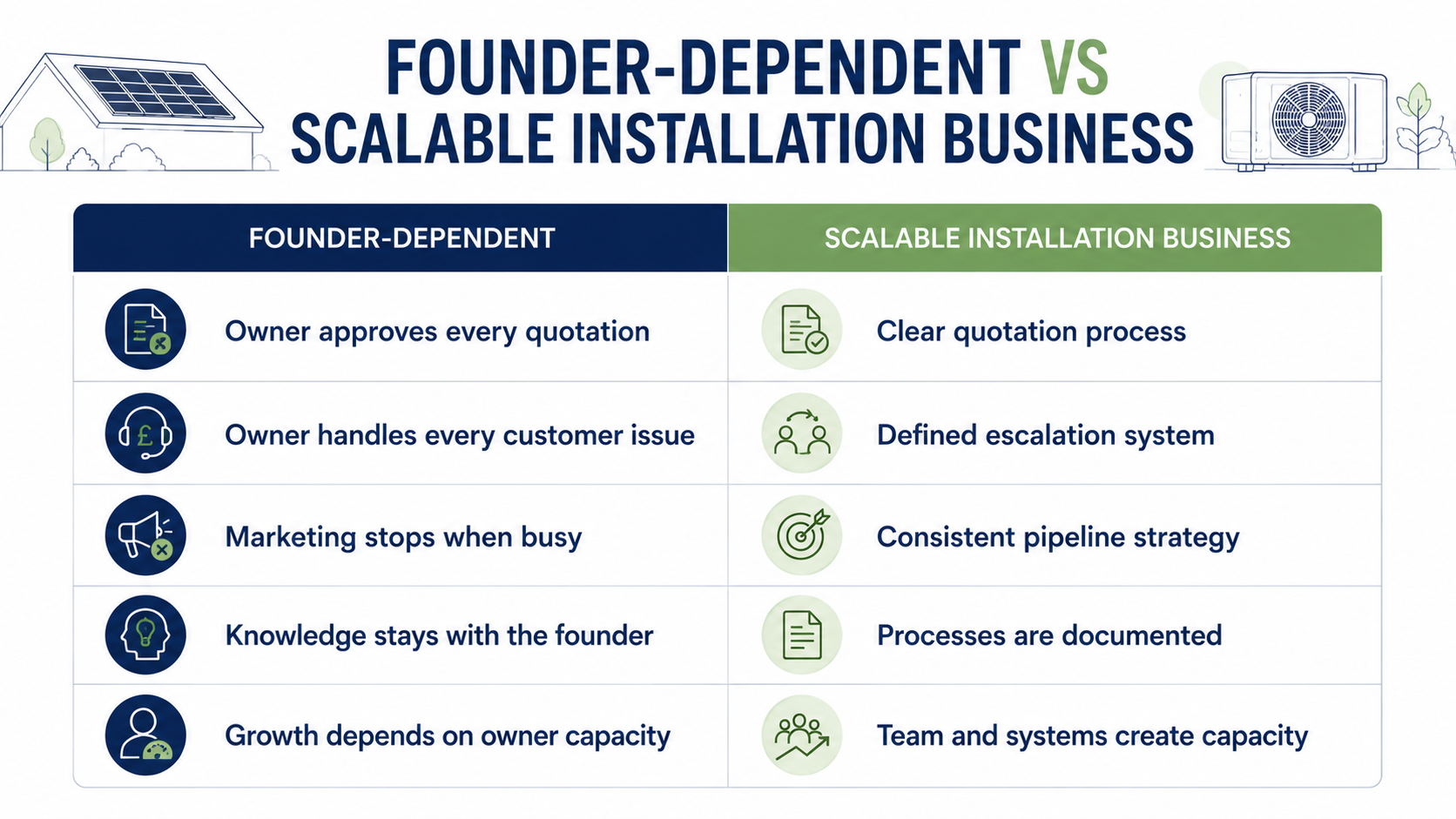
If every quotation needs the owner's approval, the quotation process can only move as quickly as the owner. If every customer complaint is escalated to the founder, the business becomes dependent on their availability. If only one person understands how surveys are scheduled or marketing performance is assessed, that knowledge becomes a restriction on growth.
The founder effectively becomes the company's capacity limit.
This is not necessarily caused by poor management. In many cases, the owner has simply developed processes informally over several years. Decisions that feel obvious to them have never been documented because there was previously no need to explain them to someone else.
Scaling exposes these gaps.
A useful way to assess founder dependency is to consider what would happen if the owner stepped away from daily operations for two weeks. Which decisions would stop? Which tasks would be delayed? Which team members would be unsure how to proceed?
The answers can identify where processes, delegation or training are needed.
Marketing Cannot Be Treated as an Emergency Activity
One of the most common growth challenges for installation businesses is inconsistent marketing.
When the diary is quiet, generating enquiries becomes urgent. Campaigns are launched, old opportunities are contacted and more attention is given to lead generation.
Once surveys and installations increase, marketing becomes less important because the team is busy delivering the work.
Several weeks or months later, the existing pipeline begins to reduce. Marketing is restarted, but there is a delay between generating new opportunities and converting them into completed installations.
This creates a repeated cycle of high and low workloads.
A business-owner mindset treats pipeline development as an ongoing operational requirement rather than an emergency response to an empty diary.
This does not mean marketing spend must remain identical throughout the year. Budgets and activity can be adjusted according to capacity, seasonal trends and performance. However, these decisions should be planned using business data rather than made simply because the team feels busy.
Owners also need enough understanding of marketing to evaluate whether it is contributing to the company's objectives. Outsourcing activity does not remove the need for oversight. The business should still understand the type of opportunities being generated, the cost involved and what happens to those opportunities further down the pipeline.
Sales Is Part of the Customer Experience
Sales can be an uncomfortable subject for technically focused business owners. Many installers do not want their companies associated with aggressive tactics or pressure-based selling.
A professional sales process should not require either.
For renewable installation businesses, sales should help homeowners understand whether a project is suitable, what the proposed system could achieve and what level of investment is likely to be required.
The surveyor or sales representative must connect technical recommendations with the homeowner's reason for making an enquiry.
A customer concerned about rising oil costs may need to understand how the proposed heating system addresses their current problem. A homeowner considering solar may be more interested in long-term energy costs than the technical specifications of individual components.
Technical information remains important, but information alone does not always help a homeowner make a decision.
A scalable business therefore creates a more consistent sales journey. Key questions are asked during qualification and surveys. Investment expectations are discussed appropriately. Quotations are clear, and follow-up is planned rather than left to individual memory.
This creates a more reliable customer experience and makes sales performance easier to review.
Processes Make Delegation Possible
Hiring more people does not automatically remove pressure from the owner.
If new employees receive limited guidance and every unusual situation still requires the founder's input, the company may increase payroll without significantly increasing operational capacity.
Delegation works more effectively when the expected process is clear.
Installation businesses do not need a large corporate manual for every activity. Simple documented workflows can provide enough structure for recurring tasks.
For example, a survey booking process might define how appointments are confirmed, when reminders are sent and what happens after a cancellation. A quotation process can establish the information required before a proposal is prepared and the expected follow-up schedule after it is issued.
Documenting these activities creates consistency and makes training easier.
It also allows the owner to review the process itself rather than repeatedly correcting individual mistakes.
If the same problem continues to occur, management can ask whether the workflow is unclear, whether additional training is required or whether responsibility has been assigned to the wrong role.
This is a more scalable approach than solving the same problem personally each time it appears.
Business Owners Build Capacity Before It Becomes Urgent
Growth creates pressure on different areas of an installation company at different times.
More opportunities may require additional survey capacity. Higher conversion rates can increase demand on installation teams. Additional projects create more administration and customer communication.
Businesses that only react once a department is overwhelmed often experience delays and inconsistent service.
Thinking like a business owner involves looking further ahead.
If survey diaries are consistently approaching capacity, the company can begin reviewing recruitment or scheduling before appointments become difficult to manage. If installation volumes are increasing, operational requirements can be assessed before the existing team reaches its limit.
This does not mean hiring aggressively based on optimistic forecasts. Capacity planning should be supported by performance data and realistic pipeline visibility.
The objective is to understand which part of the business is likely to become the next constraint.
When owners spend all of their time solving today's operational problems, identifying tomorrow's bottleneck becomes much more difficult.
Moving From Installer to Business Owner Is a Gradual Process
There is no single point at which a founder stops being an installer and becomes a business owner.
For many companies, the transition happens gradually. The owner begins by delegating administration, then creates a clearer quotation process. Marketing performance is reviewed more regularly, and team members gain responsibility for operational decisions.
The most important change is how the owner uses their time.
Instead of asking only what work needs to be completed today, they also consider what the business needs to improve over the next six or twelve months.
This may involve reviewing conversion data, developing managers, improving customer communication or creating a more consistent source of survey opportunities.
Technical expertise does not become less valuable during this transition. It becomes part of a wider set of business capabilities.
Building a Renewable Installation Business That Can Grow
A successful renewable installation company needs excellent technical delivery, but sustainable growth requires more than workmanship alone.
Marketing, sales and operations cannot be expected to organise themselves as volume increases. Processes need to become clearer, responsibilities must be distributed and the owner must gradually create enough space to work on the direction of the company.
For installers trying to grow, one of the most useful questions is not simply how to complete more installations.
It is whether the current business can support more installations without placing every additional responsibility back on the founder.
Building that capacity takes time, but it creates a stronger foundation for long-term growth.
If your business has survey capacity and needs a more consistent flow of qualified appointments, InstallrHub allows UK heat pump and solar installers to claim pre-booked surveys in the areas they cover.
Ready to fill your surveyors' diaries? Claim your pre-booked appointments here: